Best Laser Levels New Zealand 2026: 4 Green Cross-Line Lasers Tested


Whether you are fitting garage shelving, tiling a kitchen splashback, setting out a laundry renovation, aligning cabinetry or marking posts for a deck or pergola, the result only looks right if everything is properly straight, both horizontally and vertically. A spirit level is fine for a quick check, but once you need to line up longer runs, such as cabinets, tile rows or power points, a cross-line laser level quickly proves its value.
These compact green laser levels project clear reference lines onto the wall, floor or ceiling, leaving your hands free to position and adjust materials with far better control.
To find the best laser levels for New Zealand DIY users and light trade work, we tested 38 cross-line laser levels. We assessed accuracy, ease of use, durability and overall performance, with particular attention to jobs where precision matters most, such as fitting cabinets, tiling a splashback and setting out straight lines across a room.
During testing, it became clear that the best model was not necessarily the most expensive. One cross-line laser stood out because it combined strong 4×360° projection, self-levelling, a clear green laser, remote control and a complete accessory kit — while costing roughly half as much as several more expensive competitors.
That made the overall value hard to ignore. For most DIY users and renovation projects, it is smarter to choose a model that gives you more functionality, better usability and more accessories for your money, rather than paying extra for a well-known brand name. That is why we placed strong emphasis on real value for money in this comparison.
Why choose a green laser level for renovation work?
Precision and accuracy
Cross-line lasers offer noticeably better measuring accuracy and alignment precision than conventional spirit levels. They create clean, straight reference lines, making them ideal for tiling, framing work and cabinet installation.
Saves time
They cut down setup time and remove much of the guesswork from the job, helping projects move along more quickly and efficiently.
Versatile use
Cross-line lasers are useful across a wide range of jobs, including:
Construction work (framing, plasterboard, levelling concrete surfaces)
Interior finishing (hanging pictures, fitting shelves, hanging wallpaper)
Outdoor projects (ground levelling, fence building, garden and landscaping work)
Hands-free working
Many models include a tripod or mounting bracket, making hands-free work much easier during a project.
Long working range
High-quality cross-line lasers can project lines across long distances, making them well suited to larger indoor and outdoor projects.
Before buying one of these genuinely useful tools, read on for what matters when choosing the best laser level New Zealand users can rely on for renovation, tiling, cabinetry and weekend DIY projects.
What to look for in a self-levelling 360° cross-line laser
360° laser coverage
One of the biggest advantages of a 360° cross-line laser is that it can project a full 360° line or plane. This covers the working area around the device, making continuous alignment possible in every direction.
Another benefit is strong close-range projection, which helps with accurate work in tighter spaces or on smaller jobs.
A 360° model gives you all-round projection from a single setup. It improves efficiency, reduces potential errors and opens up a wider range of uses, making it a more practical long-term choice overall.
Self-levelling models
A cross-line laser with self-levelling automatically corrects its position, even if the unit is placed slightly unevenly. That is especially useful for beginners, as it saves time and improves accuracy.
Tough construction
Look for a laser with a tough build and materials that can handle practical use. A sturdy housing made from metal or high-quality plastic helps protect the sensitive internal components. Dust and splash protection also matter.
An IP54 rating or better is recommended. The more often you plan to use the laser outdoors, the more important protection against dust, dirt and water becomes.
What you should usually avoid
Red laser beams
Cross-line lasers with a red beam are often much harder to see in bright conditions than green-beam models. A green laser is easier for the human eye to detect and usually offers a better working range. For larger or brighter jobs, green is the more sensible choice.
No replaceable batteries
Avoid models without replaceable batteries. With swap-out batteries, you can simply replace a flat battery with a charged one, helping you avoid interruptions during longer jobs or in places where recharging is not practical.
If the battery fails in a model with a fixed internal power source, the whole tool often has to be replaced or repaired at considerable cost. A model with replaceable batteries is usually more cost-effective and longer-lasting.
Poor accuracy or weak calibration
Accuracy is central when using a cross-line laser. Choose a model with high precision, usually stated in millimetres over 10 metres or in fractional inches.
A laser with poor calibration or low accuracy can lead to costly mistakes, both on professional jobs and DIY projects at home.
How we assessed the products
We put practical use ahead of specifications alone, so the assessment reflects how a cross-line laser actually performs in common renovation and installation jobs.
What matters most when buying
- Self-levelling
- Setup and first use (cross-line laser)
- Visibility
- Measurement accuracy
- Power supply
- Accessories
- Practical features
- Robustness and durability
The 4 best laser levels in New Zealand for 2026
We compared more than 38 models and cross-checked our impressions against user feedback. The four options below stood out overall, and the table gives you a quick side-by-side view of price, best use case and the key advantage of each green laser level before you read the full reviews.
| Rank | Product | Best for | Price | Key advantage | Link |
|---|---|---|---|---|---|
| No. 1 · Best overall | Seektool LX360 Pro 4×360° green laser level | DIY, home renovation, tiling and light trade work | NZ$398 | 4×360° green laser level and complete accessory bundle | Check latest price |
| No. 2 | Bosch GRL 400 H | Outdoor levelling and general worksite tasks | NZ$1,109 | Robust choice for routine jobs and longer distances | Check latest price |
| No. 3 | Huepar | Users who want 4×360° features and app control | NZ$699 | 4×360° projection and Bluetooth control | Check latest price |
| No. 4 | Makita SK105GDZ | Simple indoor alignment, shelves and cabinets | NZ$579 | Compact and easy to handle | Check latest price |
Seektool LX360 Pro 4×360° green laser level
Best for: DIY, home renovation, tiling and light trade work
Price: NZ$398
Key advantage: 4×360° green laser level and complete accessory bundle
Check latest priceBosch GRL 400 H
Best for: Outdoor levelling and general worksite tasks
Price: NZ$1,109
Key advantage: Robust choice for routine jobs and longer distances
Check latest priceHuepar
Best for: Users who want 4×360° features and app control
Price: NZ$699
Key advantage: 4×360° projection and Bluetooth control
Check latest priceMakita SK105GDZ
Best for: Simple indoor alignment, shelves and cabinets
Price: NZ$579
Key advantage: Compact and easy to handle
Check latest priceNo. 1: Seektool LX360 Pro 4×360° green cross-line laser
Our top overall pick for accuracy, coverage and included accessories.
Pros
- Recently upgraded with app control — promotional pricing stays unchanged for a limited time
- Four 360° laser lines for full-room coverage
- Very high accuracy
- Self-levelling
- Very long working range
- Remote control for easier operation
- Protective rubber housing
- Includes a magnetic mounting base
- Rechargeable battery
- Comes with a full accessory set, including a matching tripod.
- Excellent value for money, offering a high-end feature experience without the heavy brand premium
- The best warranty in this comparison
Cons
- Only available online
- Frequently out of stock due to strong demand
Our review
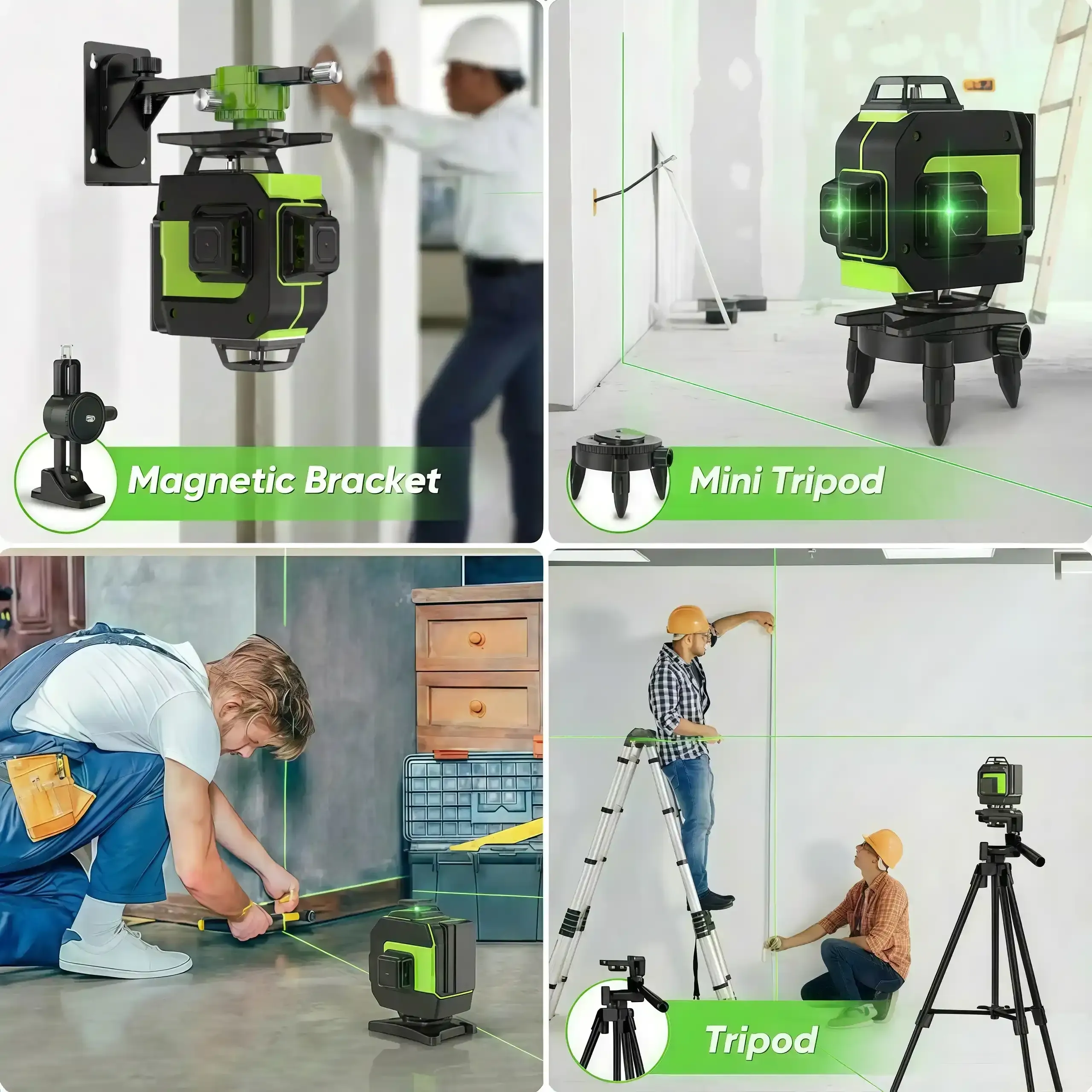
Whether you need it for DIY work at home or on a professional worksite, this cross-line laser from Seektool has most of what the majority of users are likely to need. It also feels like a professional-grade model, with a wide range of beam options, all in green for clear visibility, even outdoors. Two horizontal 360-degree beams and two vertical 360-degree beams can be combined to suit different jobs.
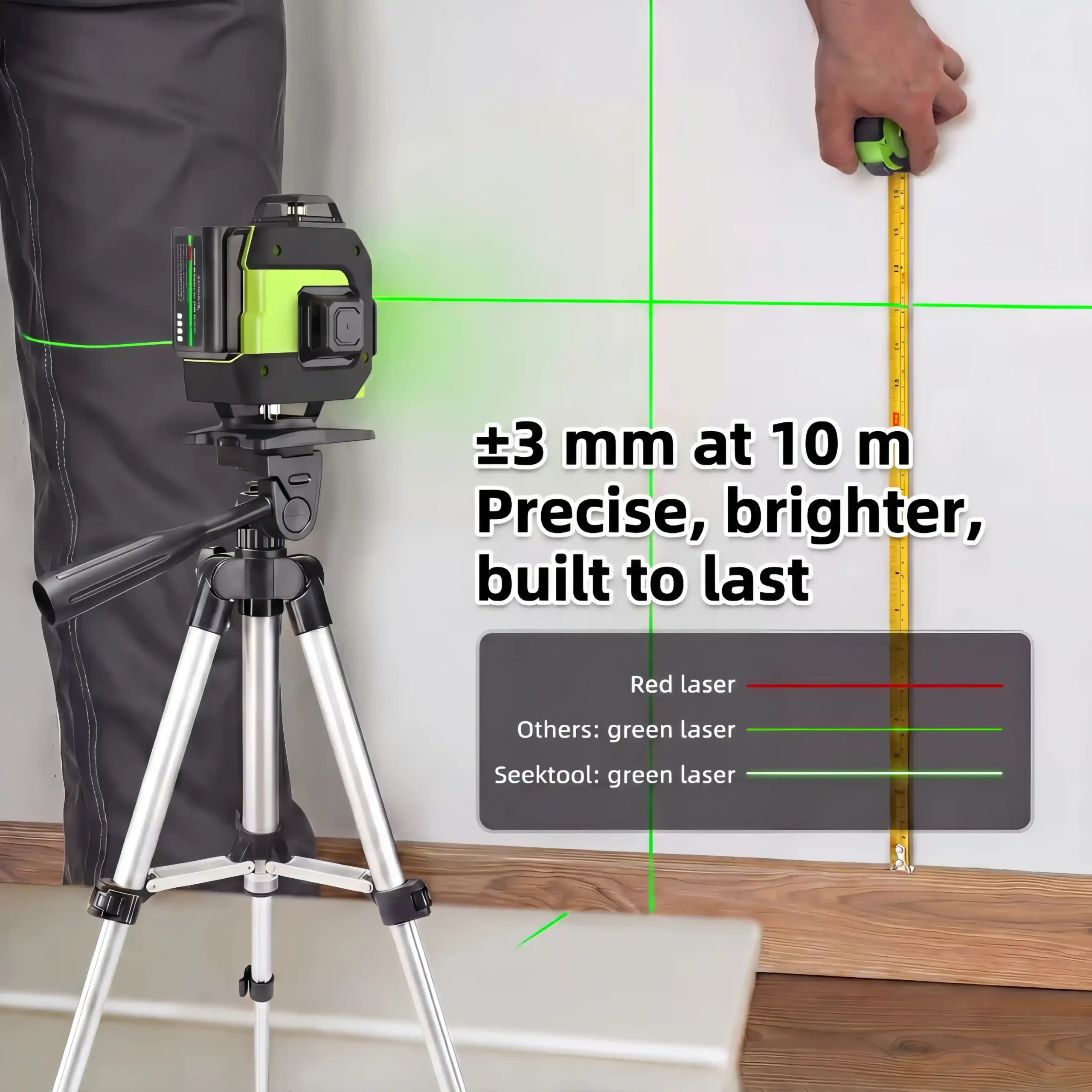
In our testing, this professional tool was easy to use and levelled itself accurately. The lines landed exactly where expected, both vertically and horizontally. In addition to IP54 protection against dust and water ingress, the model also offers drop resistance up to one metre.
The laser’s usable range is up to 30 metres indoors, so you can set vertical, horizontal or cross lines even in larger rooms.
The manufacturer’s stated tolerance is ±3 mm over 10 m, and in our handling the line remained stable even after the drop test. Battery life reached up to around 16 hours in testing, depending on the mode used.
In the box, you get a mini tripod, a magnetic bracket, a remote control, a spare battery and a carry case, which can save extra purchases depending on your setup.
All things considered, Seektool is exactly what you would hope for in this category, and our top pick for the best cross-line laser overall.
No. 2: Bosch GRL 400 H
A dependable option for routine site work and outdoor levelling.

Pros
- Vertical, horizontal and cross lines
- Versatile beam configurations
- High-quality build
- Well suited to construction and site work
Cons
- No dual-axis levelling, only single-axis
- Expensive for buyers who do not specifically need a rotary laser for outdoor or site-level work
- No remote-control or Bluetooth support
- Battery performance is limited under continuous use
Our review
The Bosch GRL 400 H is a dependable rotary laser for typical site tasks and for outdoor or ground-levelling work.
It is worth noting, however, that the GRL 400 H only supports single-axis self-levelling. That means that on uneven surfaces, the other axis needs to be adjusted manually to make sure it is properly level.
Another important point is that the battery life of this cross-line laser may not be enough for heavier use. In our testing, the GRL 400 H performed well under normal conditions, but for longer working sessions a spare battery becomes fairly essential. That may be a limitation for projects requiring continuous operation. It also lacks Bluetooth and remote-control features, making it less convenient for solo users.
In short, the Bosch GRL 400 H performs well in terms of functionality and design, but for more demanding measuring tasks, such as long-distance high-precision work, slope adjustment, vertical projection and remote operation, it may not be the best fit.
No. 3: Huepar
A feature-rich mid-range model with 4×360° projection and Bluetooth control.
Pros
- Four 360-degree lasers for full-room coverage
- Accurate and clearly visible lines
- Self-levelling up to 5 degrees
Cons
- Unreliable Bluetooth function with delays and dropouts
- Longer charging time
- Quite bulky and a little awkward in day-to-day use
- Relatively expensive considering the Bluetooth reliability issues
- No slope mode
Our review
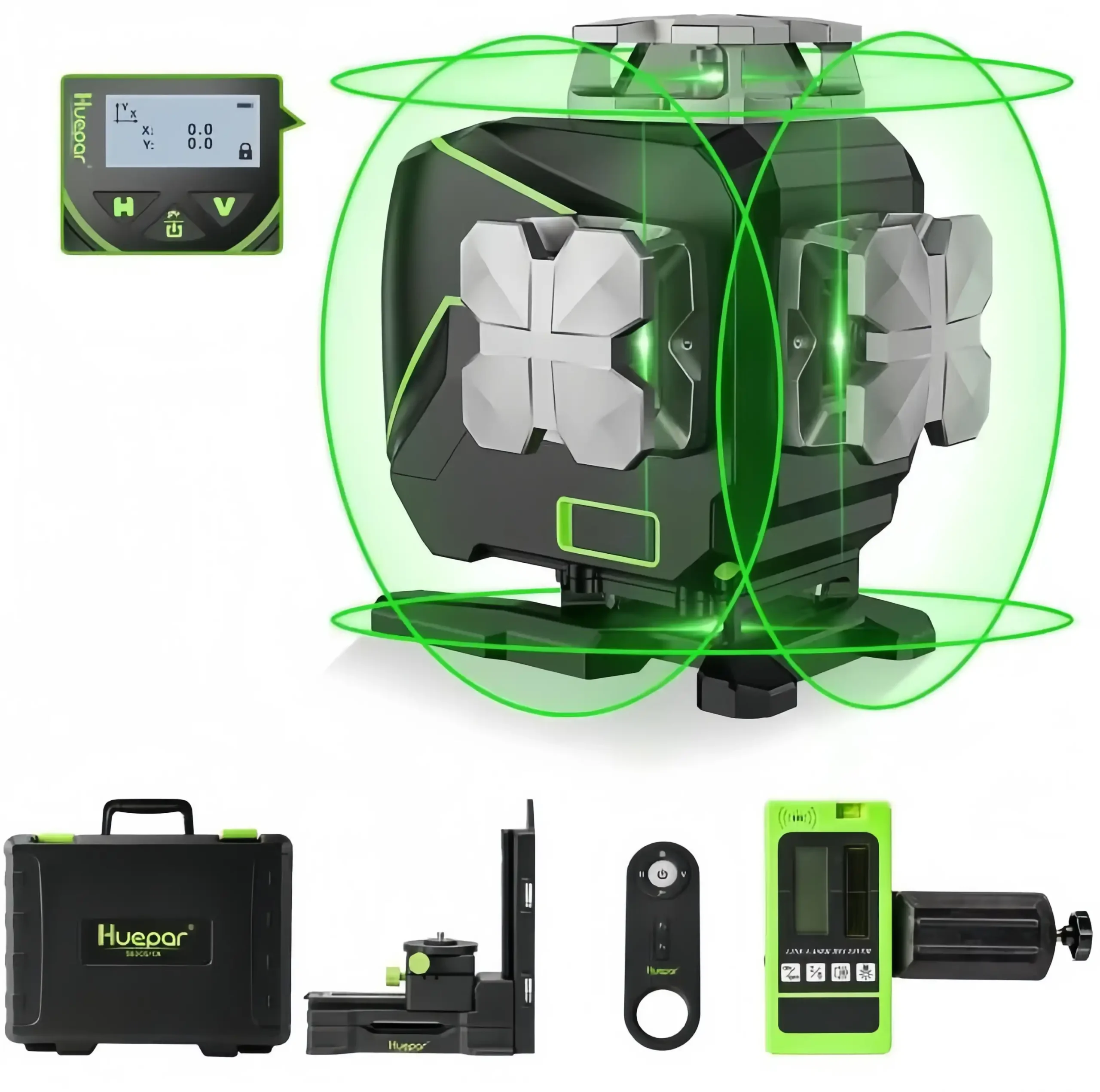
The Huepar Bluetooth 4×360 cross-line laser (S04CG-5RG) is a feature-rich mid- to upper-priced laser suitable for most building applications. The 4×360-degree laser projection is highly practical, and Bluetooth control adds more flexibility in use, which can be particularly helpful on larger projects or more complex measuring jobs.
In testing, however, we found that the Bluetooth connection could respond with a delay and occasionally drop out, which is particularly frustrating when you want to make quick adjustments.
As a multifunction cross-line laser, the Huepar S04CG-5RG supports multi-directional laser projection, but it does not include a slope mode. That means it cannot automatically project laser lines on an incline or gradient. This limitation makes it less suitable for jobs that require precise slope settings, such as flooring installation or pipework.
For more general applications, the Huepar performs well, but for specialist work where precision is critical, we would lean towards a different model.
No. 4: Makita SK105GDZ
A compact basic choice for simpler indoor alignment work.
Pros
- Rechargeable battery
- Compact and easy-to-handle design
Cons
- Accuracy is not strong enough over longer distances
- No magnetic base included
- No remote control
- Limited battery life
- No 360° laser projection like some comparable models
- Expensive for a more basic cross-line laser without 360° projection or remote control
Our review
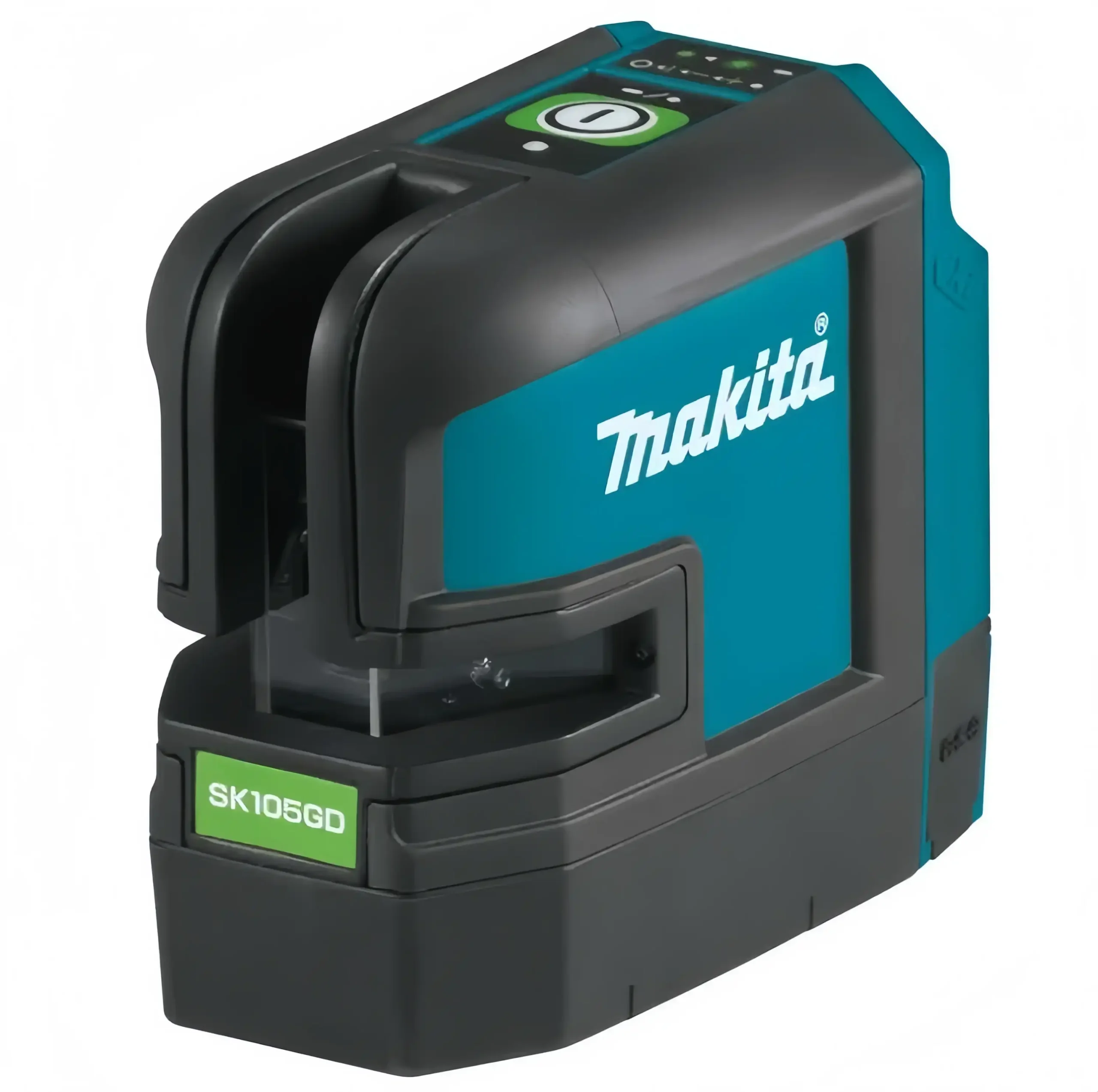
The Makita SK105GDZ 12V Max Green cross-line laser is a robust and portable tool designed for general indoor construction work.
The SK105GDZ offers a stated accuracy of ±3 mm at 10 m, which is sufficient for most building requirements over shorter distances. However, accuracy drops off noticeably beyond 15 m, making it less suitable for longer spans.
Compared with some competing products in the same price range, the Makita SK105GDZ only offers a standard cross-line projection and does not include 360° panoramic laser projection, which may reduce efficiency in use.
Another point worth noting is that it does not include a built-in magnetic base. It can only be stabilised with a tripod or additional brackets. By contrast, some competing models, such as Seektool, often come with strong magnetic mounts that make fixing them to metal surfaces much easier.
Overall, this is a cross-line laser with more basic functionality. If you need higher precision or more advanced features such as 360° projection, remote control or slope mode, it is probably worth skipping this one.
Best overall
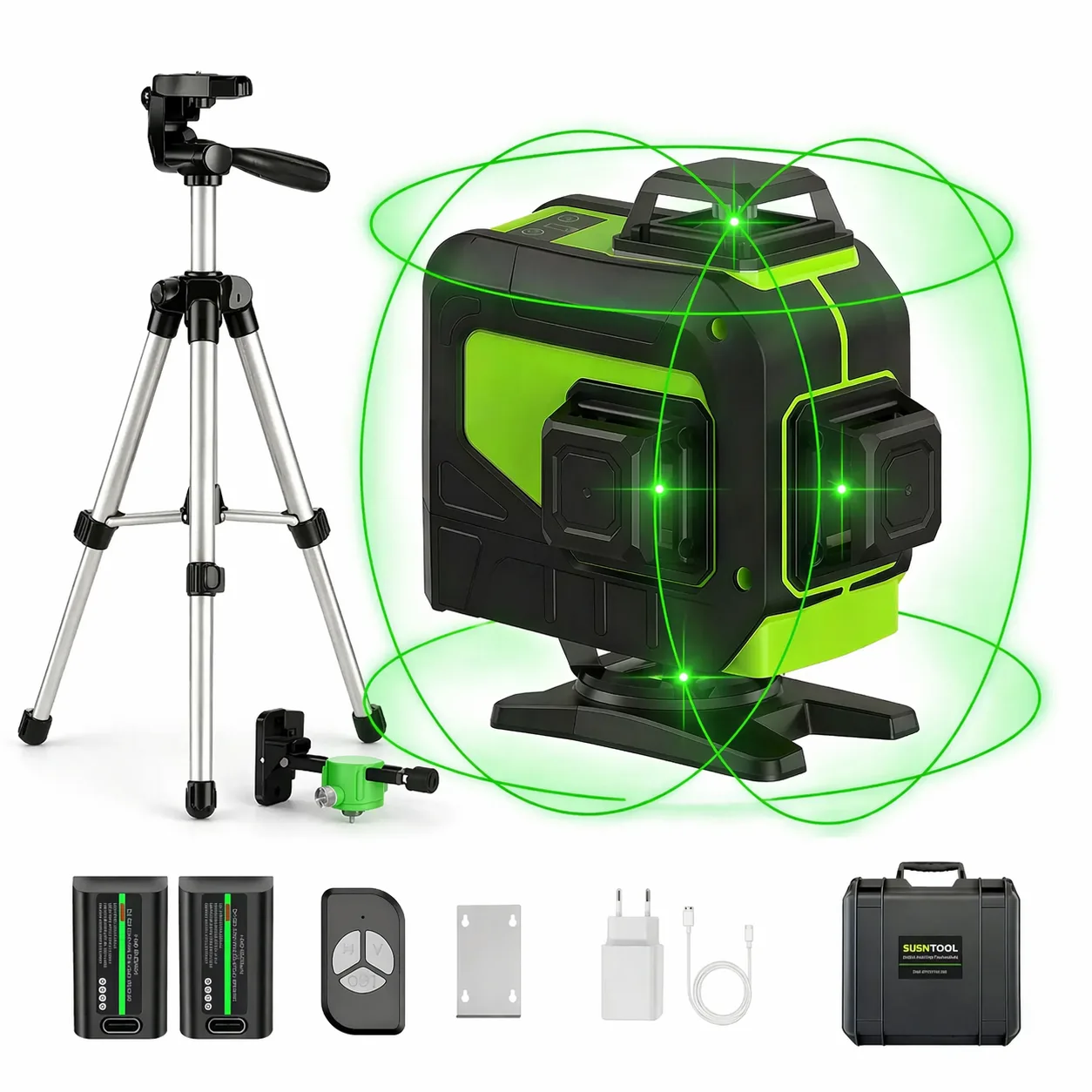
Seektool LX360 Pro 4×360° green laser level
Best for New Zealand DIY users and light trade work where full-room coverage, green visibility and a strong accessory bundle matter.
- 4×360° laser lines
- Green laser with good visibility
- Complete accessory bundle
- Excellent value for money
Save 35% now
Check latest priceFrequently asked questions
What is the best laser level for home renovation in New Zealand?
For most New Zealand home renovation jobs, the best laser level is usually a self-levelling green laser level with clear visibility, practical mounting options and enough accuracy for tiling, shelving, cabinetry and laundry or kitchen fit-outs. A 360° laser level is especially useful if you need continuous reference lines around a room.
Is a green laser level better than a red laser level?
In most cases, yes. A green laser level is generally easier for the human eye to see than a red one, especially in bright rooms, garages and larger indoor spaces. If you want clearer projection lines for renovation, tiling or cabinet installation, green is usually the better choice.
Is a 360° laser level worth it?
That depends on the kind of work you do. If you only occasionally hang a picture or fit a single shelf, a more basic laser level may be enough. But if you regularly work on full-wall alignment, cabinet runs, tiling, ceiling work or jobs that require continuous projection lines, a 360° laser level is much more convenient and usually saves time.
What does self-levelling laser level mean?
A self-levelling laser level automatically aligns the laser lines when placed on a slightly uneven surface. It saves time and reduces the risk of user error. This is especially useful for DIY users because setup becomes easier and alignment mistakes are less likely.
What laser level is best for tiling and cabinets?
For tiling and cabinets, choose a green self-levelling laser level with strong horizontal and vertical lines, stable calibration and a mounting setup that lets you position the beam at the right working height. For longer cabinet runs, splashbacks and wall-to-wall tiling, a 360° laser level is much easier to work with than a basic two-line unit.
Can I use a green laser level outdoors in New Zealand?
Yes, but performance depends heavily on the model and conditions. Strong New Zealand daylight can make laser lines much harder to see, so a unit that performs well indoors may feel less effective outside. If outdoor use matters to you, prioritise a brighter green laser, good rated range, solid dust and water protection, and possible detector support.
How accurate should a laser level be for DIY and light trade work?
For most home renovation and indoor installation work, accuracy of ±3 mm over 10 m is usually sufficient. That is generally accurate enough for shelving, cabinet fitting, tiling, track installation and other everyday alignment tasks.
Headline accuracy is not the only thing that matters. Stability after repositioning, calibration consistency and self-levelling performance also affect real-world results. For most New Zealand DIY users and light trade work, a laser level rated at ±3 mm over 10 m with dependable real-world performance is usually the more practical choice.
Disclaimer
Designed to help users make confident decisions online, this website contains information about a range of products and services. Certain details, including but not limited to prices and special offers, are provided to us directly by our partners and may change at any time without prior notice. Although based on careful research, the information we share does not constitute legal or professional advice, and should not be treated as such.
Reproduction in whole or in part is strictly prohibited.
As an Amazon Associate we earn from qualifying purchases.